





Paul Silvia
- Media Contact
- SPN Mentor
I'm interested in the intersection of motivation and cognition, particularly how people guide their thoughts and how emotional states motivate thinking.
My research on self-awareness examines how self-focused attention influences self-evaluation. Recent work has explored the role of conscious awareness in the self-evaluation process and how self-awareness influences the self-regulation of effort-related cardiovascular responses. This research has been supported by grants from the National Institute of Mental Health (NIMH).
In ongoing work, we are examining anhedonia in adults with Major Depressive Disorder (MDD). Using mainstream models of effort from motivation science, we can unpack the psychological factors that give rise to depressive anhedonia. An ongoing NIMH grant is funding a project that uses cardiac psychophysiology and experience sampling to examine effort deficits in both the ab and daily life.
Another line of work concerns the emotion of interest, particularly the vexing problem of what makes things interesting, boring, and confusing. Most of this work is carried out in the domain of aesthetics and the arts, such as visual art, poetry, and film. My work on interest and aesthetic emotions received the Berlyne Award, an early career award given by APA Division 10. My work is summarized in a 2006 book, Exploring the Psychology of Interest, and a 2008 article in Current Directions in Psychological Science.
Finally, we have an active program of work on creativity, particularly how people come up with creative ideas. In addition to developing new methods of assessment and scoring, we have developed a model of creative thought that emphasizes executive and strategic aspects of cognition. A line of behavioral and neuroimaging studies has offered strong support for our approach. Our work is currently funded by a grant from the Imagination Institute, and a recent article in Trends in Cognitive Sciences summarizes our work to date.
Regarding methods, I'm interested in experience-sampling techniques for studying the psychology of everyday life. We've used ESM to study a range of problems, such as mindwandering, musical imagery, aberrant perceptual experiences, everyday creativity, and social disinterest. Integrating ESM into intervention research is a particular interest of mine. My collaborators and I have applied experience sampling designs to a range of clinical and at-risk populations, including adults with MDD in a psychotherapy trial and college students with ADHD taking part in an intervention intended to improve college success.
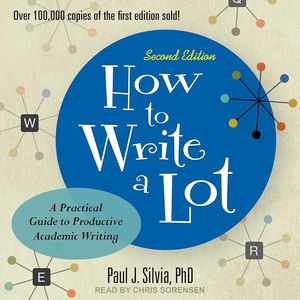
Some years ago I wrote a short book called "How To Write A Lot": it describes how to overcome the motivational and self-regulatory problems involved in academic writing. If you find writing difficult, struggle with "finding time to write," or believe that psychology books should have a lot of distracting, irrelevant remarks about coffee, Icelandic, and Bernese mountain dogs, then you might find the book helpful. My latest book, "Write It Up," focuses on how to write and publish empirical articles. It discusses strategies for crafting influential articles, navigating the journal process, cultivating a strong writing style, and deciding what work is worth our limited writing time.
Primary Interests:
- Emotion, Mood, Affect
- Motivation, Goal Setting
- Research Methods, Assessment
- Self and Identity
- Social Cognition
Note from the Network: The holder of this profile has certified having all necessary rights, licenses, and authorization to post the files listed below. Visitors are welcome to copy or use any files for noncommercial or journalistic purposes provided they credit the profile holder and cite this page as the source.
Image Gallery
Video Gallery

"Ordinary Creativity" in Everyday Life (2021 Annual Torrance Lecture)
Select video to watch
-
1:28:53 "Ordinary Creativity" in Everyday Life (2021 Annual Torrance Lecture)
Length: 1:28:53
-
1:01:32 How to Publish a Lot and Still Have a Life (Part 1)
Length: 1:01:32
-
44:47 How to Publish a Lot and Still Have a Life (Part 2)
Length: 44:47
-
32:00 How to Publish a Lot and Still Have a Life (Part 3)
Length: 32:00
-
1:18:05 How to Publish a Lot and Still Have a Life (Part 4)
Length: 1:18:05
Books:
- Duval, T. S., & Silvia, P. J. (2001). Self-awareness and causal attribution: A dual systems theory. Boston: Kluwer Academic Publishers.
- Feldman, D. B., & Silvia, P. J. (2010). Public speaking for psychologists: A lighthearted guide to research presentations, job talks, and other opportunities to embarrass yourself. Washington, DC: American Psychological Association.
- Silvia, P. J. (2006). Exploring the psychology of interest. New York: Oxford University Press.
- Silvia, P. J. (2007). How to write a lot: A practical guide to productive academic writing. Washington, DC: American Psychological Association.
- Silvia, P. J., Delaney, P. F., & Marcovitch, S. (2009). What psychology majors could (and should) be doing: An informal guide to research experience and professional skills. Washington, DC: American Psychological Association.
Journal Articles:
- Duval, T. S., & Silvia, P. J. (2002). Self-awareness, probability of improvement, and the self-serving bias. Journal of Personality and Social Psychology, 82, 49-61.
- Kane, M. J., Brown, L. H., Little, J. C., Silvia, P. J., Myin-Germeys, I., & Kwapil, T. R. (2007). For whom the mind wanders, and when: An experience-sampling study of working memory and executive control in daily life. Psychological Science, 18, 614-621.
- Nusbaum, E. C., & Silvia, P. J. (2011). Are intelligence and creativity really so different? Fluid intelligence, executive processes, and strategy use in divergent thinking. Intelligence, 39, 36-45.
- Nusbaum, E. C., & Silvia, P. J. (2011). Shivers and timbres: Personality and the experience of chills from music. Social Psychological and Personality Science, 2, 199-204.
- Silvia, P. J. (2008). Interest -- the curious emotion. Current Directions in Psychological Science, 17, 57-60.
- Silvia, P. J. (2005). Emotional responses to art: From collation and arousal to cognition and emotion. Review of General Psychology, 9, 342-357.
- Silvia, P. J. (2005). What is interesting? Exploring the appraisal structure of interest. Emotion, 5, 89-102.
- Silvia, P. J. (in press). Mirrors, masks, and motivation: Implicit and explicit self-focused attention influence effort-related cardiovascular reactivity. Biological Psychology.
- Silvia, P. J., & Beaty, R. E. (in press). Making creative metaphors: The importance of fluid intelligence for creative thought. Intelligence.
- Silvia, P. J., & Duval, T. S. (2001). Objective self-awareness theory: Recent progress and enduring problems. Personality and Social Psychology Review, 5, 230-241.
- Silvia, P. J., & Kwapil, T. R. (in press). Aberrant asociality: How individual differences in social anhedonia illuminate the need to belong. Journal of Personality.
- Silvia, P. J., & Nusbaum, E. C. (2011). On personality and piloerection: Individual differences in aesthetic chills and other unusual aesthetic experiences. Psychology of Aesthetics, Creativity, and the Arts, 5, 208-214.
- Silvia, P. J., Henson, R. A., & Templin, J. L. (2009). Are the sources of interest the same for everyone? Using multilevel mixture models to explore individual differences in appraisal structures. Cognition and Emotion, 23, 1389-1406.
- Silvia, P. J., Jones, H. C., Kelly, C. S., & Zibaie, A. (2011). Masked first name priming increases effort-related cardiovascular reactivity. International Journal of Psychophysiology, 80, 210-216.
- Silvia, P. J., Winterstein, B. P., Willse, J. T., Barona, C. M., Cram, J. T., Hess, K. I., Martinez, J. L., & Richard, C. A. (2008). Assessing creativity with divergent thinking tasks: Exploring the reliability and validity of new subjective scoring methods (With six comments and a rejoinder). Psychology of Aesthetics, Creativity, and the Arts, 2, 68-85.
Courses Taught:
- Academic Writing and Publishing
- Advanced Research Methods
- Advanced Social Psychology
- Attitudes and Social Influence
- Careers in Psychology
- Cognition & Emotion
- Interest, Curiosity, and Intrinsic Motivation
- Motivation & Emotion
- Psychology of Art, Creativity, & Genius
- Social Psychology
- Theories of Personality
Paul Silvia
Department of Psychology
University of North Carolina at Greensboro
P.O. Box 26170
Greensboro, North Carolina 27402-6170
United States of America
- Phone: (336) 256-0007
- Fax: (336) 334-5066
